Open source · MIT licensed · PHP 8.2+
php-chatbot-assistant
A self-hosted AI chatbot platform
Train it on your own documents and drop one script tag on your site. Answers come out of your content, the conversations stay in your PostgreSQL database, and nobody bills you per seat, per bot or per message.
- MIT license
- No framework
- PostgreSQL 16 + pgvector
- 282 unit tests
- 2 retrieval strategies — vector RAG or PageIndex
- 30+ industry prompt presets, several per industry
- 1 script tag to put a bot on any website
- $0 per seat, per bot, per conversation
What you get
A complete chatbot product, not a demo script
Clone it, run the installer, add your API keys. Everything a client-facing chatbot needs — tenancy, training pipeline, widget, lead capture, permissions and audit trail — is already in the box.
Chatbots per tenant
Create, clone and manage as many bots as you like. Each one carries its own model settings, system prompt, widget styling and allowed domains.
Document Q&A
Upload PDF, DOCX, TXT or Markdown. The pipeline parses, chunks, embeds and indexes it automatically, and shows you the status of every step.
Two retrieval strategies
Classic vector search in pgvector, or PageIndex — an LLM navigating a document outline with no embeddings at all. Choose per chatbot.
AI lead capture
The bot asks for a name, email and phone inside the conversation — no modal, no form. Leads are extracted, stored and summarised per conversation.
Quick answers
Trigger-based canned replies that fire before the model is ever called. Common questions cost nothing and come back instantly.
Authentication, finished
Argon2id passwords, magic links, TOTP with recovery codes, account lockout, per-IP rate limiting, CSRF tokens and rotating sessions.
Retrieval
Two ways to answer from your documents
Most chatbots force one retrieval model on you. Here it is a per-chatbot setting, so you can use embeddings where they are strongest and skip them where they get in the way.
Vector search
Documents are chunked, embedded with text-embedding-3-small (1536
dimensions) and stored in pgvector with an IVFFlat index. At query time the question is
embedded and the nearest chunks are returned by cosine distance.
- Fast, proven and predictable on cost
- Ideal when answers live inside individual paragraphs
- Index is ready as soon as ingestion finishes
Vectorless navigation
Documents are parsed into a hierarchy of headings and sections. The model skims the outline, picks the sections that matter and reads only those — the way a person uses a table of contents.
- No chunk boundaries to split an answer in half
- Strong on long, well-structured documents
- Fewer embedding calls; outline skimming stays cheap
The widget
One script tag, and it is on your site
The embed snippet is generated from your chatbot's own settings — colours, header text, placeholder and position all update live as you edit them, and the code panel rewrites itself as you go.
<script src="https://your-server.com/widget.js"
        data-widget-token="YOUR_WIDGET_TOKEN"
        data-api-base="https://your-server.com"
        data-bot-name="Support"
        data-primary-color="#2563eb"
        data-position="bottom-right"
        data-widget-theme="light"></script>
- Shadow DOM — your site's CSS cannot break the widget, and the widget cannot break your site.
- Light and dark panels, custom primary, gradient, accent and header colours.
- Quick answer chips loaded when the panel opens, plus typing indicators.
- Expandable — drag either edge to resize the panel width.
- Ratings — an inactivity-triggered 1–5 star bar per conversation.
- Locked down — allowed-domain CORS restriction so a copied snippet is useless on someone else's site.
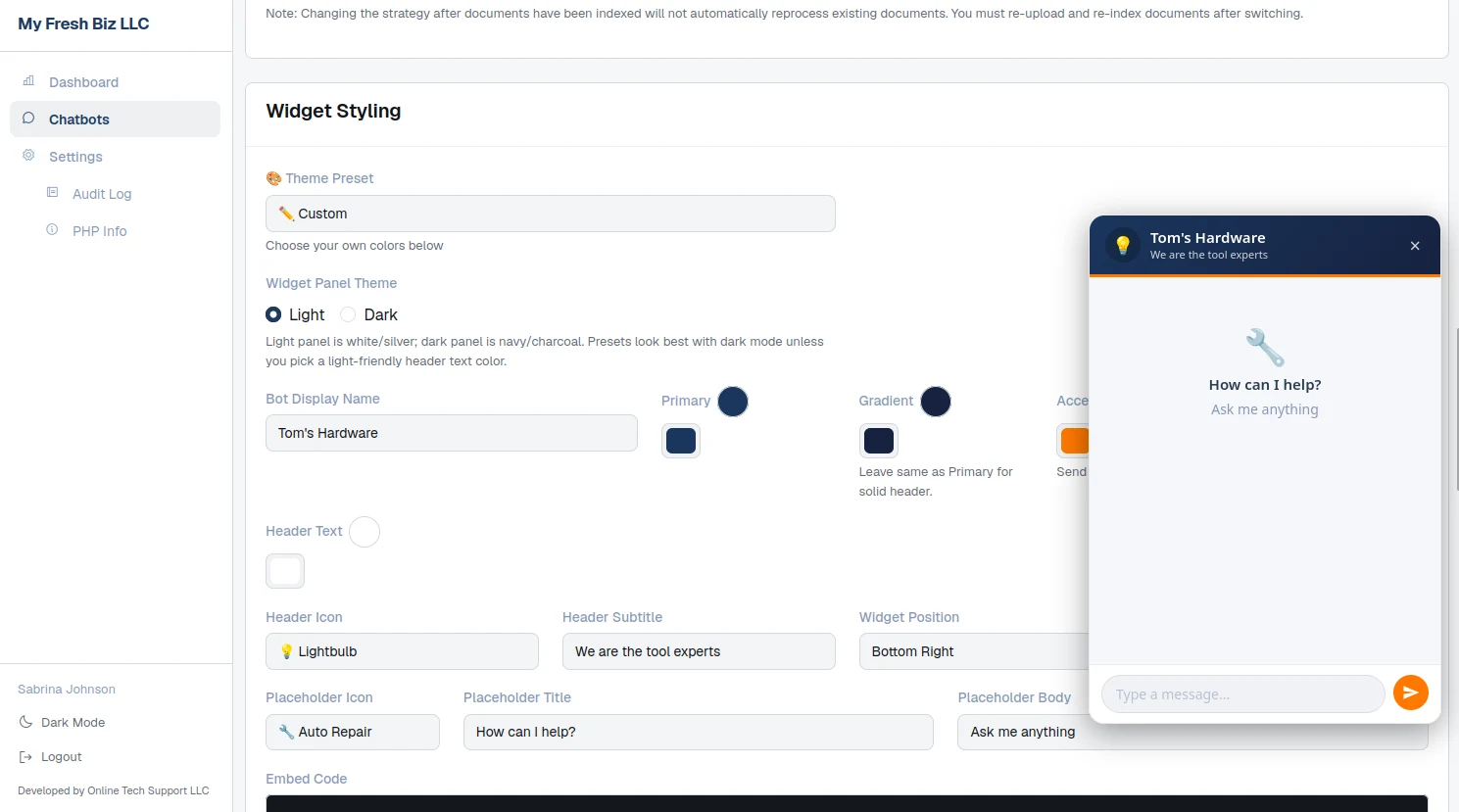
Widget styling with the live preview — every field on the left is reflected in the panel on the right, and in the embed code underneath.
Inside the product
Seventeen screens, from first login to audit trail
Click any screen to open it full size. Use the arrow keys to move through the set, Escape to close.
Dashboard and analytics
2 screensChatbots, training and results
4 screensThe chatbot builder, top to bottom
6 screensAccounts, roles and the audit trail
5 screensInstallation
Running on your own server in about fifteen minutes
- PHP 8.2+ with pdo_pgsql and mbstring
- PostgreSQL 16+ with the pgvector extension
- Composer
- An OpenAI API key
-
Clone the repository and install its two dependencies
git clone https://github.com/OnlineTechSupportBiz/php-chatbot-assistant.git
cd php-chatbot-assistant/pca
composer install
Composer and the application live in
pca/. Point your web server's document root at its siblingpublic_html/, which holds the front controller, the installer, the widget and the assets. -
Open install.php and work through the installer
Visit
https://your-server.com/install.php. The three-step wizard configures the database connection, runs the migrations and creates the super-admin account — it checks the PHP extensions, the PostgreSQL version and the vector extension before it writes anything. -
Register a user account and add its API keys
Create a user account from the login screen, then sign in as that user and open Settings to save the OpenAI key (used for embeddings and chat) and the LlamaCloud key (used to parse uploaded documents). The keys belong to the account, not the server, so each tenant brings its own. You can also switch registration off in the admin dashboard and create client accounts yourself.
-
Create a chatbot and train it
Pick an industry preset or write your own system prompt, choose vector RAG or PageIndex, then upload a document. The pipeline runs parse → chunk → embed → index and reports the status of every step.
-
Embed the widget and restrict it to your domain
Copy the snippet from the chatbot page and paste it into your site before
</body>. Add the domains allowed to use that widget token, so a copied snippet fails anywhere else.
Verify the install
php vendor/bin/phpunit tests/Unit/
282 tests cover the models, controllers, routing, auth, rate limiting, prompt-injection detection, retrieval strategies and XSS sanitisation, using mocked databases so nothing outside your machine is contacted.
Under the hood
Clean PHP, PostgreSQL and nothing you have to babysit
PSR-4 classes, no framework, no queue server and no external vector database. If you can run a PHP site you can run this.
| Layer | Technology |
|---|---|
| Backend | PHP 8.2+, PSR-4, no framework |
| Database | PostgreSQL 16 with pgvector (IVFFlat index) |
| Tenancy | Row-Level Security on a session-scoped tenant id |
| Embeddings | OpenAI text-embedding-3-small, 1536 dimensions |
| Chat model | Configurable per chatbot, GPT-4o-mini or GPT-4.1-mini class by default |
| Parsing | LlamaCloud Parse for PDF, DOCX, TXT and Markdown |
| Auth | Argon2id, TOTP via otphp, magic links |
| Widget | Vanilla JavaScript in a Shadow DOM, with Marked for Markdown |
| PHPMailer over your own SMTP server |
Abuse protection before the model is called
Every guardrail is evaluated before any API request goes out, so a blocked request costs you nothing and a hostile one does not reach your invoice.
- Rate limiting — a configurable number of messages per minute per session.
- Daily token budget — a hard per-chatbot cap, with the current model's spend estimate beside it.
- Maximum message length — oversized prompts are rejected outright.
- Maximum messages per conversation — limits how deep one session can run.
- Prompt-injection detection — pattern scanning with a polite, silent refusal.
- Audit trail — every guardrail trigger is logged with its context.
- Tenant isolation — PostgreSQL Row-Level Security, never a user id trusted from client input.
Questions
Before you clone it
What does it cost to run?
Do I need Docker or a Node toolchain?
public_html.
Where does my data — and my clients' data — live?
Can I host several clients on one installation?
Traditional RAG or PageIndex — which should I choose?
How do I put the chatbot on a website?
</body> on the site, then add that
site's domain to the chatbot's allowed-domain list. The widget runs in a Shadow DOM, so it
inherits nothing from the host page's CSS and cannot leak styles back into it.
Own your chatbot stack
Clone it, run the installer, and put an AI assistant on your website that answers from your own content — on infrastructure you control.
MIT licensed · PHP 8.2+ · PostgreSQL 16 + pgvector